Model Deployment and MLOps Services for Scalable, Production-Ready ML Systems
Quokka Labs engineers production-ready ML deployment and MLOps architectures that optimize model serving, infrastructure, automation, observability, and lifecycle performance across scalable production environments while controlling costs.
Advanced MLOps Solutions Engineered for Scale, Performance, and Lifecycle Control
Quokka Labs engineers MLOps environments that automate model deployment, optimize serving infrastructure, strengthen observability, and manage continuous model evolution across scalable production workloads.
Governed AI Deployment Solutions
Deploy AI Workloads With Runtime Control
Deploy AI applications with runtime guardrails, policy enforcement, prompt validation, risk scoring, sensitive-data protection, monitoring, and audit controls across multi-model production environments.
Deploy production chatbots that connect models with enterprise knowledge, APIs, databases, CRM platforms, support systems, retrieval pipelines, monitoring, and controlled escalation workflows.
Model Deployment and MLOps Services for Production-Scale ML Operations
Quokka Labs delivers Model Deployment and MLOps Services that bridge ML development with production execution, connecting models to applications, workflows, infrastructure, and evolving technology environments.
01
Model Serving Solutions
Deploy models through REST and gRPC inference endpoints, model servers, autoscaling, load balancing, request batching, health probes, traffic routing, and version-aware serving for latency-sensitive workloads.
02
MLOps Platform Development
Build MLOps platforms around experiment tracking, model registries, CI/CD and continuous training pipelines, validation gates, artifact lineage, environment promotion, approval workflows, and reproducible releases.
03
Model Infrastructure Solutions
Engineer production ML infrastructure across GPU and CPU compute, Kubernetes clusters, container runtimes, persistent storage, networking, secrets management, workload isolation, and infrastructure-as-code.
04
Inference Infrastructure Engineering
Optimize inference workloads through GPU utilization, model quantization, dynamic batching, concurrency controls, caching, autoscaling, memory optimization, and hardware-aware serving to manage latency and compute economics.
05
ML Workflow Orchestration
Orchestrate data ingestion, feature engineering, training, evaluation, model registration, deployment, monitoring, and retraining through DAGs, dependency management, scheduling, retries, triggers, and pipeline observability.
06
Edge AI Deployment Solutions
Deploy ML inference across edge devices using model quantization, hardware acceleration, offline inference, secure model updates, device telemetry, OTA deployment, and centralized fleet management.
Client Success Stories
Proven MLOps Engineering Delivering Real-World Business Outcomes
Explore how Quokka Labs applies MLOps engineering to govern AI runtimes, automate quality workflows, and operationalize intelligent applications across complex production environments and business processes.
Langprotect
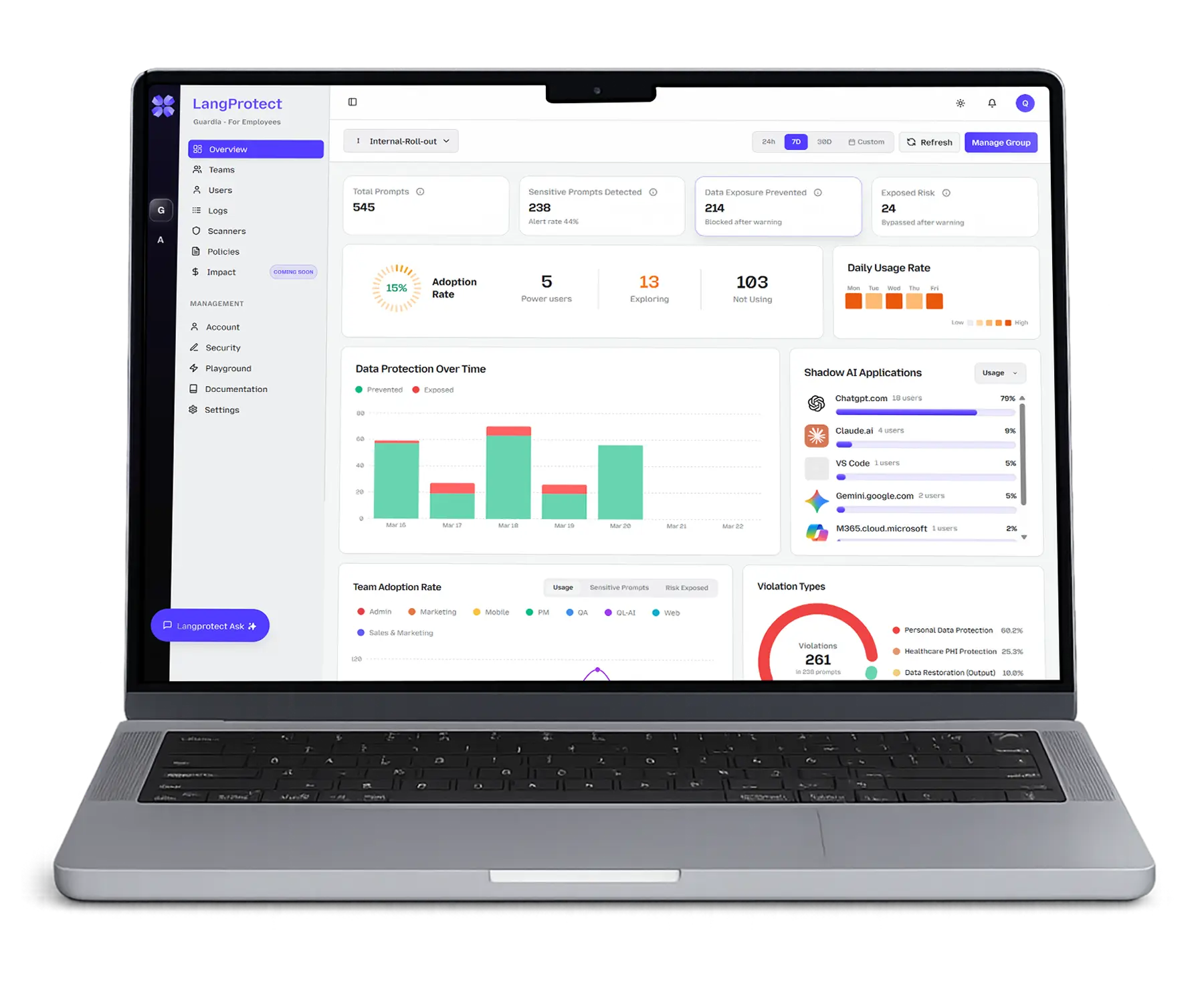
Quokka Labs engineered production LLM infrastructure with runtime security controls, AI activity monitoring, sensitive-data protection, and continuous governance to support controlled model serving and reliable releases.
Quokka Labs operationalized Rhubarb’s GPT-based assistant with RAG pipelines, LangChain agents, scalable inference, personalization, and production workflows supporting reliable AI delivery across gardening applications.
Quokka Labs deployed RTD’s GPT-based RAG assistant with knowledge integration, contextual memory, workflow connectivity, and production deployment supporting reliable AI assistance across registration and event operations.
How We Turn ML Readiness Into Governed Production Execution
Quokka Labs aligns model readiness, infrastructure architecture, deployment controls, observability, and lifecycle decisions to establish accountable production environments built around security, performance, reliability, and measurable outcomes.
1
Model & Infrastructure Assessment
Evaluate model dependencies, inference patterns, data contracts, compute requirements, latency thresholds, throughput targets, security controls, infrastructure capacity, and production constraints to establish deployment readiness.
2
MLOps Architecture
Define serving architecture, model registries, orchestration layers, CI/CD pathways, observability, identity controls, environment boundaries, release strategies, and governance mechanisms aligned with workload requirements.
3
Pipeline & Environment Setup
Establish reproducible environments using containers, infrastructure-as-code, artifact repositories, CI/CD automation, configuration management, secrets handling, validation gates, and controlled promotion across development and production stages.
4
Model Deployment & Serving
Release validated models through inference servers, APIs, endpoints, traffic routing, autoscaling, health checks, canary releases, version management, and rollback mechanisms aligned with production service requirements.
5
Monitoring & Performance Management
Track infrastructure health, inference latency, throughput, resource utilization, data quality, model behavior, drift signals, availability, and business indicators through centralized observability and actionable alerting.
6
Continuous Optimization & Retraining
Use production telemetry, drift detection, performance trends, utilization data, and changing workload requirements to trigger model optimization, retraining, validation, redeployment, or lifecycle retirement decisions.
Deploy clinical prediction, medical imaging, patient-risk, and diagnostic models across EHR, EMR, HL7, FHIR, DICOM, and PACS environments with HIPAA-aligned safeguards, PHI protection, audit trails, and controlled inference.
Deploy clinical prediction, medical imaging, patient-risk, and diagnostic models across EHR, EMR, HL7, FHIR, DICOM, and PACS environments with HIPAA-aligned safeguards, PHI protection, audit trails, and controlled inference.
Secure Model Deployment With Governance Across the ML Lifecycle
Quokka Labs embeds security controls, identity management, data protection, model traceability, deployment policies, and auditability across ML infrastructure, pipelines, serving environments, and lifecycle workflows.
NIST AI RMF
ISO/IEC 42001
ISO/IEC 23894
OECD AI Principles
NIST AI RMF
ISO/IEC 42001
ISO/IEC 23894
OECD AI Principles
MITRE ATLAS™
OWASP ML Security
Kubernetes Security
Container Security
Secrets Management
Network Isolation
Runtime Protection
MITRE ATLAS™
OWASP ML Security
Kubernetes Security
Container Security
Secrets Management
Network Isolation
Runtime Protection
GDPR
HIPAA
CCPA/CPRA
EU AI Act
DPDP Act
SOC 2
GDPR
HIPAA
CCPA/CPRA
EU AI Act
DPDP Act
SOC 2
MLflow
Arize AI
Fiddler AI
Evidently AI
WhyLabs
OpenTelemetry
MLflow
Arize AI
Fiddler AI
Evidently AI
WhyLabs
OpenTelemetry
OAuth 2.0
OpenID Connect
SSO
RBAC
Encryption
Data Loss Prevention
OAuth 2.0
OpenID Connect
SSO
RBAC
Encryption
Data Loss Prevention
Partner With Us
Why Choose Quokka Labs for Predictable ML Performance and Business Value
Quokka Labs helps technology leaders build dependable ML capabilities that improve decision-making, strengthen delivery consistency, optimize resource utilization, and support evolving business requirements at scale.
Infrastructure Portability
Across cloud, private, hybrid, and edge environments, our architects create portable ML foundations using containers, Kubernetes, infrastructure-as-code, and standardized deployment interfaces.
Environment Consistency
With reproducible environments as a baseline, we establish parity across development, staging, and production through containerized runtimes, dependency controls, immutable artifacts, and automated promotion.
Production-Grade Reliability
Our engineering standards prioritize resilient ML environments with defined availability targets, fault tolerance, health validation, graceful recovery, rollback readiness, and dependable serving under production demand.
Inference Economics
We align model-serving architecture with workload economics, optimizing quantization, batching, accelerator utilization, autoscaling, and capacity planning without compromising required inference performance.
Release Engineering Discipline
Through inference monitoring, model and behavior change detection, hallucination tracking, resilience testing, version governance, and rollback strategies, we support AI reliability as models, data, and usage patterns evolve.
Observability Depth
Executive governance models establish AI ownership, approval authorities, escalation workflows, governance reporting, human review checkpoints, and lifecycle accountability to support transparent, policy-aligned AI system governance.
Let's engineer your ML environment around the performance, control, and scale your organization requires.
Technologies Powering Modern Model Deployment and MLOps
We select proven ML, cloud, infrastructure, serving, orchestration, and observability technologies around model architecture, workload requirements, deployment environments, performance objectives, and long-term maintainability.
OpenAI
ML Engineering Insights
Insights on Model Deployment, MLOps, and Production ML
Explore experts' perspectives on model serving, inference architecture, deployment automation, ML observability, infrastructure economics, and lifecycle decisions shaping production machine learning environments.
How to Build an AI Adoption Roadmap That Ensures Measurable ROI
AI has evolved from a competitive advantage to a boardroom expectation. Yet, beneath the enthusiasm, the results tell a
Trusted by Teams Building and Scaling Intelligent Systems
Quokka Labs brings established engineering practices, cross-functional expertise, and production delivery experience to complex ML initiatives requiring dependable execution, technical depth, and long-term support.
0+
Years of Engineering Excellence
0+
AI Models Deployed & Integrated
0+
Engineers, Architects & AI Specialists
0+
Industries Served
Start Your MLOps Initiative
Ready To Build ML Capabilities That Perform Beyond the Prototype?
Whether you are productionizing existing models or establishing an MLOps foundation, Quokka Labs helps technology leaders build dependable ML capabilities aligned with scale, governance, and evolving business priorities.
Production Readiness Assessment
Validate model readiness, infrastructure requirements, deployment constraints, and performance targets before production.
Architecture-Led MLOps
Architect ML environments around workload behavior, security, scalability, observability, and reliable serving.
Lifecycle Engineering & Optimization
Monitor model behavior, drift, infrastructure performance, retraining needs, and production changes continuously.
Talk to Our MLOps Experts
Model Deployment and MLOps Services FAQs
What is model deployment?
Model deployment is the process of making a trained machine learning model available for inference within a production application, workflow, API, or device. It involves packaging the model, preparing its runtime environment, exposing inference interfaces, configuring compute resources, establishing security controls, and validating production behavior.
What is MLOps?
MLOps is a set of engineering practices that automates and manages the machine learning lifecycle from experimentation and training through deployment, monitoring, retraining, and retirement. It combines machine learning, software engineering, DevOps, infrastructure, data engineering, and governance practices to make model delivery reproducible and manageable.
What is the difference between model deployment and MLOps?
Model deployment makes a trained model available for production inference, while MLOps manages the broader processes required to develop, deploy, monitor, update, and govern models throughout their lifecycle. Deployment is therefore one stage within a larger MLOps framework.
What is model serving?
Model serving is the infrastructure and software layer that receives input data and returns predictions from a deployed machine learning model. Serving can use REST APIs, gRPC endpoints, dedicated inference servers, containerized services, or Kubernetes-based platforms depending on latency, throughput, scalability, and integration requirements.
How is ML model performance monitored after deployment?
ML model performance is monitored through a combination of infrastructure, application, data, model, and business metrics. Typical measurements include latency, throughput, error rates, availability, resource utilization, prediction distributions, data quality, drift, accuracy, precision, recall, and business-specific outcome metrics.
How can machine learning models be deployed safely?
Models can be deployed safely through validation gates, version control, automated testing, staged releases, canary deployments, blue-green deployments, shadow testing, health checks, monitoring, and rollback mechanisms. The appropriate strategy depends on model risk, traffic patterns, application dependencies, and the consequences of incorrect predictions.
What is model lineage in MLOps?
Model lineage records the relationships between datasets, features, experiments, model versions, artifacts, environments, and deployments. This traceability helps teams reproduce results, investigate production issues, understand model changes, support audits, and determine which deployed systems are affected by changes to upstream components.
Can MLOps support cloud, hybrid, private, and edge environments?
Yes. MLOps architectures can support public cloud, private infrastructure, hybrid environments, and edge deployments when the underlying networking, security, orchestration, model-serving, and monitoring requirements are appropriately designed. Containerization and infrastructure-as-code can also improve consistency across different deployment environments.
What should a production ML monitoring strategy include?
A production ML monitoring strategy should cover infrastructure health, application behavior, data quality, model performance, drift, resource utilization, latency, throughput, errors, and relevant business outcomes. Monitoring should also define thresholds, alerts, ownership, investigation procedures, and remediation workflows rather than simply collecting metrics.
What metrics are important for evaluating production ML systems?
Important production metrics include availability, latency, throughput, deployment frequency, time-to-market, inference cost per request, infrastructure utilization, drift detection time, remediation time, and pipeline success rate. Model-specific metrics such as accuracy, precision, recall, F1 score, calibration, or ranking quality should also be tracked where ground-truth outcomes are available.















.webp)